How design studios stay reachable without breaking flow
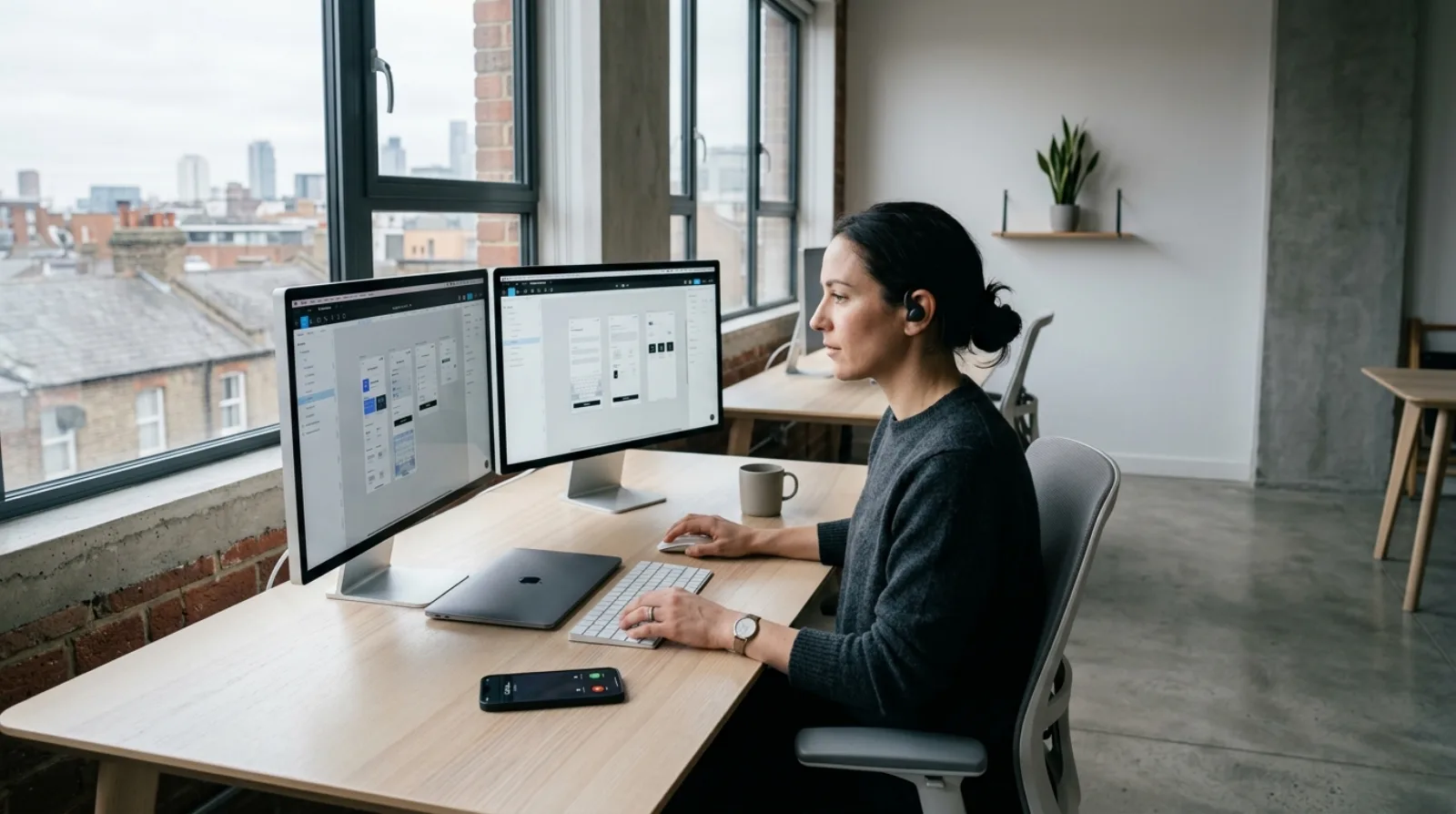
If you run a design or product studio, the best hours of the day happen with your phone face down. You're three layers deep in a Figma file, or mid debug in the IDE, and the work only holds together if nothing knocks it loose. The real question isn't how to focus. It's how to stay reachable without breaking flow, because going properly dark for six hours isn't a plan, it's a gamble.
The short version: give people a way to reach you that doesn't announce itself as an interruption, and save the loud stuff, a ringing phone, a banner notification, for the small number of things that genuinely need a live person right now rather than an answer whenever you next surface.
I run We UC, the company building Olatti, out of a 20-person dev team, and most of my week goes into watching exactly this group work: designers and engineers who live inside one tool for hours at a stretch and treat an interruption as a real cost, not a minor annoyance. It's a different instinct to the one I grew up with in telecoms, at circle.cloud, the UK telecoms company I started in 2015 that installs and supports phone systems for small businesses, where the job was answering the phone, not protecting the silence around it. A studio runs on the opposite skill.
Why a ringing phone costs a studio more than most
A phone doesn't ask whether now is a good time. It rings, and the review you were three moves into, the layout you'd finally got to sit right, the bug you'd nearly cornered, all of it has to be held in your head while you deal with the call. Put the phone down and the state you were in doesn't come back the way you left it. You pick up the thread a few minutes later, slightly worse, and start rebuilding.

That's the trade a lot of studios end up making without deciding to: leave the phone off to protect the work, and let calls go to voicemail nobody checks until the end of the day. It solves the interruption problem and creates a worse one, because the client who couldn't get through doesn't experience your focus, they experience being ignored.
What should "reachable" actually mean?
Reachable shouldn't mean someone will stop whatever they're doing the second it rings. It should mean they can be found, quickly, by the person who genuinely needs them, with everything else queued for later without feeling lost. Those are different problems, and most business phones only solve the first one, badly, by making every call as loud and as interruptive as every other call.
The fix isn't a better do-not-disturb setting. It's separating the two kinds of contact a studio actually gets: the message that can sit for an hour (most of them), and the call that genuinely can't (fewer than people assume). A tool that treats both the same way is asking you to choose between being reachable and getting anything done.
How to stay reachable without breaking flow
This is where the mechanics matter. In Olatti, reaching someone is one gesture: double-tap the hotkey from wherever you're already working, in Figma, in the terminal, in a browser tab, type a name, and press enter to call or shift-enter to message. There's no separate app to open and no dialler to hunt for, so the person calling isn't adding a second interruption on top of the first, the hunt for the right tool.

For the studio itself, that means the loud channel, an actual ring, stays for the calls that need a live person now, and everything else lands as a message you can answer between contexts rather than in the middle of one. A transcript and recording sit behind it, so if you did miss something live, you're reading what was said rather than asking someone to repeat it from memory. Nobody has to choose between finishing the thought and finding out what they missed.
Why chat tools don't fix this
Most studios already have a chat tool, and it doesn't solve reachability, it multiplies it. A channel pings the same way a call does, on a badge that wants checking, and a studio running on Slack or Teams for everything ends up with the interruption problem twice over: once from the channels, once from whichever app someone finally opens to make an actual call. We've written the fuller comparison with Slack here if that's the setup you're running on top of a phone that never quite got sorted.
The case for reaching people through the keyboard rather than a mouse and a dialler is really the same argument from a different angle: the tool should cost you as little attention as possible to use, so the decision to reach someone doesn't compete with the decision to keep working.
Protecting the hours that matter
You don't need to solve reachability for the whole studio in one go. Start with the person whose focus is costing the team the most when it breaks, usually whoever's mid-project on the hardest problem, and give them a way in that doesn't compete with the work itself. The rest of the studio can follow once that one relationship is working the way it should.
Olatti exists because I don't think being reachable and doing your best work should be opposites. If you'd like to see what a keyboard-enabled business phone looks like, have a look, or join the waitlist and I'll bring you in early.